

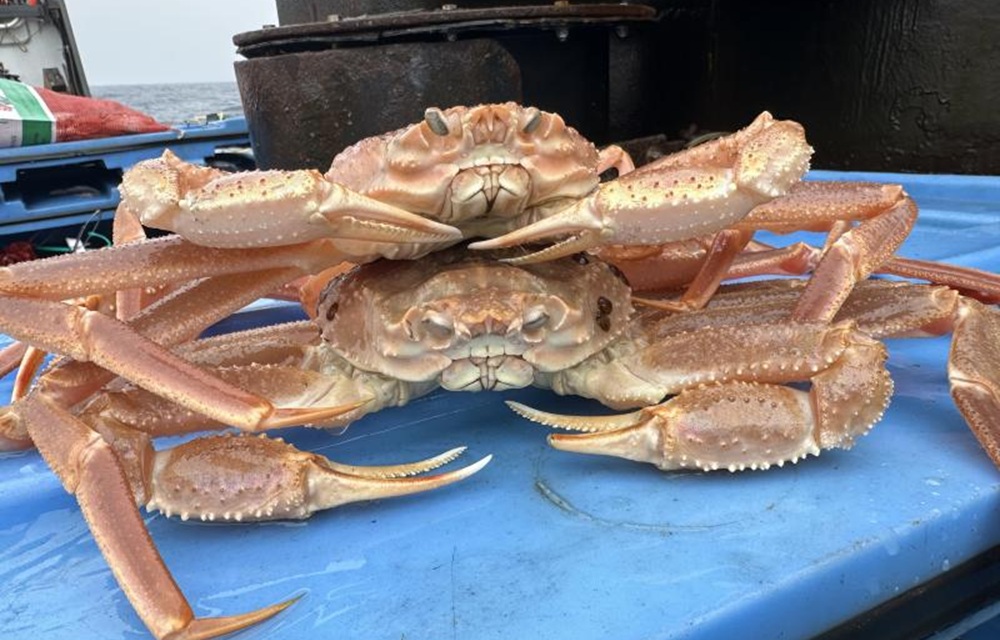
The U.S. state of Alaska has asked the U.S. Department of Commerce to issue a fishery disaster determination for the 2024/2025 Bering Sea snow crab season, which despite reopening after two years of closure, remains well below recent averages in terms of both harvest and revenue.
“The snow crab fishery has historically been the most productive crab fishery in the Bering Sea and supported one of the most valuable commercial fisheries in the Arctic,” Alaska Governor Mike Dunleavy said in his letter, which noted that the fishery recorded gross revenue peaking at USD 219 million (EUR 188 million) in the 2020/2021 season.
However, the following season saw a sharp drop off in harvest, with gross revenue barely surpassing USD 39 million (EUR 33.5 million). The 2022/2023 season was closed as regulators waited for the species to recover, as was the 2023/2024 season.
The Department of Commerce has reliably recognized the situation as a fishery disaster, awarding more than USD 230 million (EUR 198 million) in financial relief to support the struggling sector to date. The federal government awarded the Bering Sea snow crab fishery USD 94.6 million (EUR 82.3 million) for the 2021/2022 season, USD 96.7 million (EUR 83 million) for the 2022/2023 season, and USD 39.5 million (EUR 33.9 million) for the 2023/2024 season.
Now, Alaska Governor Mike Dunleavy has requested another fishery disaster determination for the 2024/2025 season.
Though the fishery did reopen for the 2024/2025 season, preliminary gross revenue of USD 21 million (EUR 18 million) remains well below the five-year average of USD 119 million (EUR 102 million).
Regulators first became aware of a decline in the snow crab population in 2021, when a bottom trawl survey indicated an imminent stock collapse. Researchers have linked the snow crab stock collapse to a 2019 marine heat wave, which has impacted several species off the coast of Alaska and in the Bering Sea.
“Available information indicates that the snow crab stock collapse resulted from natural causes related to the 2018 and 2019 marine heat wave conditions in the Bering Sea,” Dunleavy reported. “Estimated increases in caloric requirements due to temperature and observed body condition over these years suggests that starvation and competition for food when the stock was at high abundance likely played a role in the stock collapse.”
The situation is slowly improving for snow crab harvesters in the Bering Sea. After the small reopening last year, regulators decided that the stock had improved enough to double the total allowable catch (TAC) to 9.3 million pounds.
link